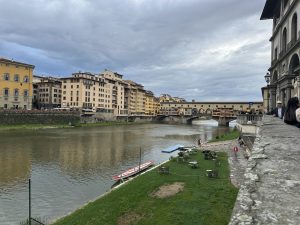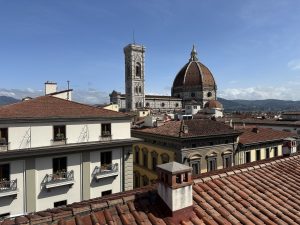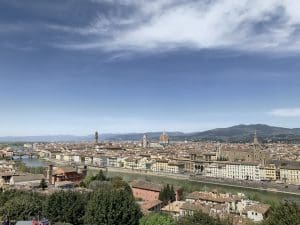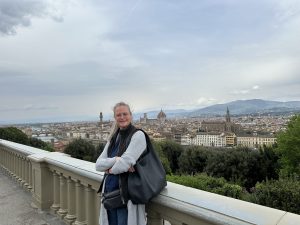
Dom

Florenz 5 (6)

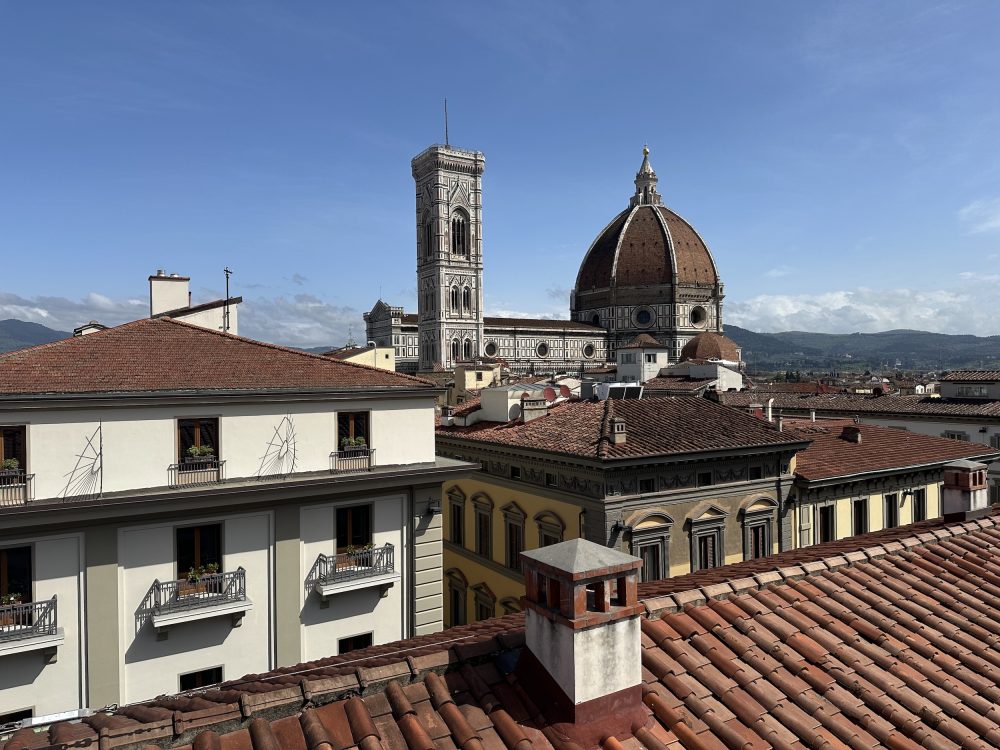
Beitragsfoto: Domblick

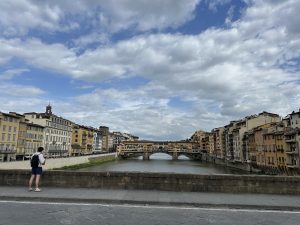
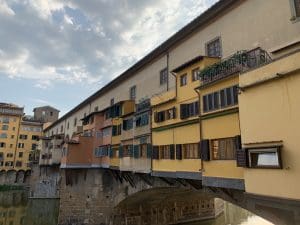
Florenz ist immer eine Reise wert. Das meinen zumindest täglich bis zu 70 000 Touristen, die durch die Innenstadt pilgern. Städte stehen und sterben mit ihren Besuchern von außerhalb, das dürfte schon immer so gewesen sein. Die Florentiner haben sich ganz gut mit ihren Besuchern arrangiert und dürften dabei auch noch den einen oder anderen Euro verdienen.

Dieses Mal bestand unsere Reisegruppe aus sieben Personen wobei die An- und Abreise von sechs erneut mit einem Bus absolviert wurde und die siebte Person den Luftweg wählte; Getrennt marschieren, gemeinsam schlagen (Moltke). Wir nutzten dabei erneut die Gelegenheit, um einen Kleinbus auf Herz und Nieren zu prüfen. Dieses Mal kam er aus Südkorea und überraschte auf ganzer Linie positiv. Die Ausstattung sehr zeitgemäß, die verbaute Technologie mir fast etwas zu schulmeisterlich. Das Nageln des Motors brachte dafür etwas Nostalgie zurück. In Florenz fanden wir dann heraus, dass es das gleiche Modell auch als E-Auto gibt. Unser Diesel musste je einmal zwischengetankt werden, was beim 2022 verwendeten Fahrzeug nicht nötig war. Interessant wäre zu wissen, ob beim E-Auto eine Tankfüllung gelangt hätte.

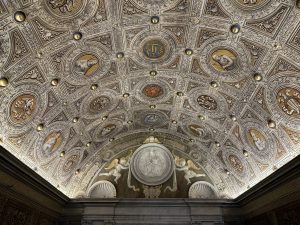
Die Alpenüberquerung dieses Mal ohne Schnörkel und der Aufenthalt in Florenz ohne weitere Abstecher, einmal vom traditionellen Fiesolebesuch abgesehen. Dafür gab es drei Tage lang Florenz pur, zu Fuß, mit dem Auto, mit dem Bus und mit der Straßenbahn.

Der Hintergrund unserer Fahrt war allerdings wieder ein ehrenamtlicher, denn wir transportieren Dokumente ins Archiv und trafen dort auf gute alte Bekannte. Da unsere diesjährige Gruppe noch nicht in Gänze das Archiv kannte, ergriff Dieter Schlenker die Gelegenheit und führte die Gruppe durch das Archiv und seine Gebäude. Erfreulich, dass Ruth Meyer die Gelegenheit nutzte und uns im Archiv traf.

Die Anfahrt zum Archiv etwas abenteuerlich. Wir nutzten die Fahrzeugnavigation und gaben dieses Mal die Adresse des offiziellen Eingangs ein. Der Navigation waren die Ausmaßes unseres Busses wohl nicht so ganz geläufig, aber wir kamen dann doch am richtigen Eingang an; die Jahre zuvor nutzten wir noch den alten Eingang, was uns immer eine Fahrt durch den Park ermöglichte.

Auf dem Gelände der Villa angekommen, bog ich einmal falsch ab und wir kamen fast bis in die Kantine. Die letzte Biegung hätte ich mit ein klein wenig Rangieren auch noch geschafft, allerdings waren die Türen dann doch für den Bus nicht breit genug.

Die Historischen Archive der Europäischen Union sind immer einen Besuch wert und dieses Jahr ganz besonders, weil das European University Institute sein 50-jähriges Bestehen feiert. Hierzu gibt es am 8. Mai 2026 einen Tag der offenen Tür, der es allen Interessierten ermöglicht, um auch einmal einen Blick hinter die Kulissen werfen zu können.

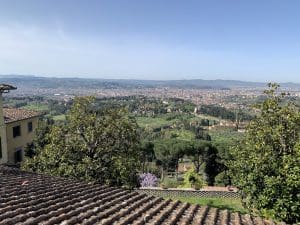
Zum Abschluss gab es dann noch eine Tour nach Fiesole, wo wir auf etruskischen, griechischen, römischen und langobardischen Spuren wandelten. Die Krönung der Abschluss in meiner Lieblingskneipe, wo wir auch den Sieg von Peter Magyar feierten.

Da unsere Gruppe ganz neu zusammengestellt war, u. a. mit Leonhard Reinwald und Semin Bristina, verließen wir ab dem folgenden Tag meine ausgetretenen Wege und fanden zumindest für mich doch noch Neues in Florenz, darunter eine Dachterrasse, die vielleicht noch mehr Charme hat als jene von den Uffizien — das Essen dürfte auf alle Fälle aber besser sein.

Da Florenz für jeden Geschmack etwas bieten kann, wurde es keinem Gruppenmitglied langweilig. Da mein für meine bessere Hälfte und mich geplanter Museumsaufenthalt sprichwörtlich ins Wasser fiel („geschlossene Gesellschaft“, was ich so auch noch nicht kannte), improvisierten Semin und ich ein wenig und besuchten ein anderes Museum, während meine bessere Hälfte ein paar Läden unsicher machte.

Von Semin inspiriert reaktivierte ich meine Google-Rezensionen und versuchte so ganz nebenbei mit ihm Schritt zu halten — ein vergebliches Unterfangen.

Neu für mich auch, dass unsere gemeinsamen Frühstücke immer damit begannen, was Donald Trump so in der letzten Nacht von sich gegeben hat. Erstaunlicher Weise schafft es dieser Mensch, sich jeden Tag erneut unterbieten zu können. Im Negativen scheint unsere Welt grenzenlos und unendlich zu sein. Wenn es ihn so oder so dereinst nicht mehr gibt, wird sich dies wohl wie das Ende der Truman Show (1998) anfühlen.

Jedem der Mitfahrer fiel und dies ganz ungefragt auf, wie sauber die gesamte Stadt ist. Die Florentiner haben erkannt, dass dies nicht nur für sie selbst viel angenehmer ist, sondern auch mit zum guten Renommee der Stadt beiträgt. Für uns Deutsche wohl unverständlich: Städte müssen nicht dreckig sein.

Auch bemerkenswert wie man den öffentlichen Nahverkehr für alle, ob Einheimische oder Fremde, sehr bequem gestaltet hat. Man steigt in den Bus oder die Straßenbahn und hält seine Debit- oder Kreditkarte an einen kleinen Automaten und das war es schon. Gäbe es das bei uns, würde ich auch ab und zu mit dem Bus fahren.

Noch besser, einfach nur Google aufmachen und man weiß, wann der benötigte Bus kommt, wo er gerade fährt und welchen Bus oder welche Bahn man als nächstes besteigen muss — keine einzige App oder sonstigen Programme sind vonnöten.


Fediverse Reactions
Dilbert

14.1.02026 5 (6)

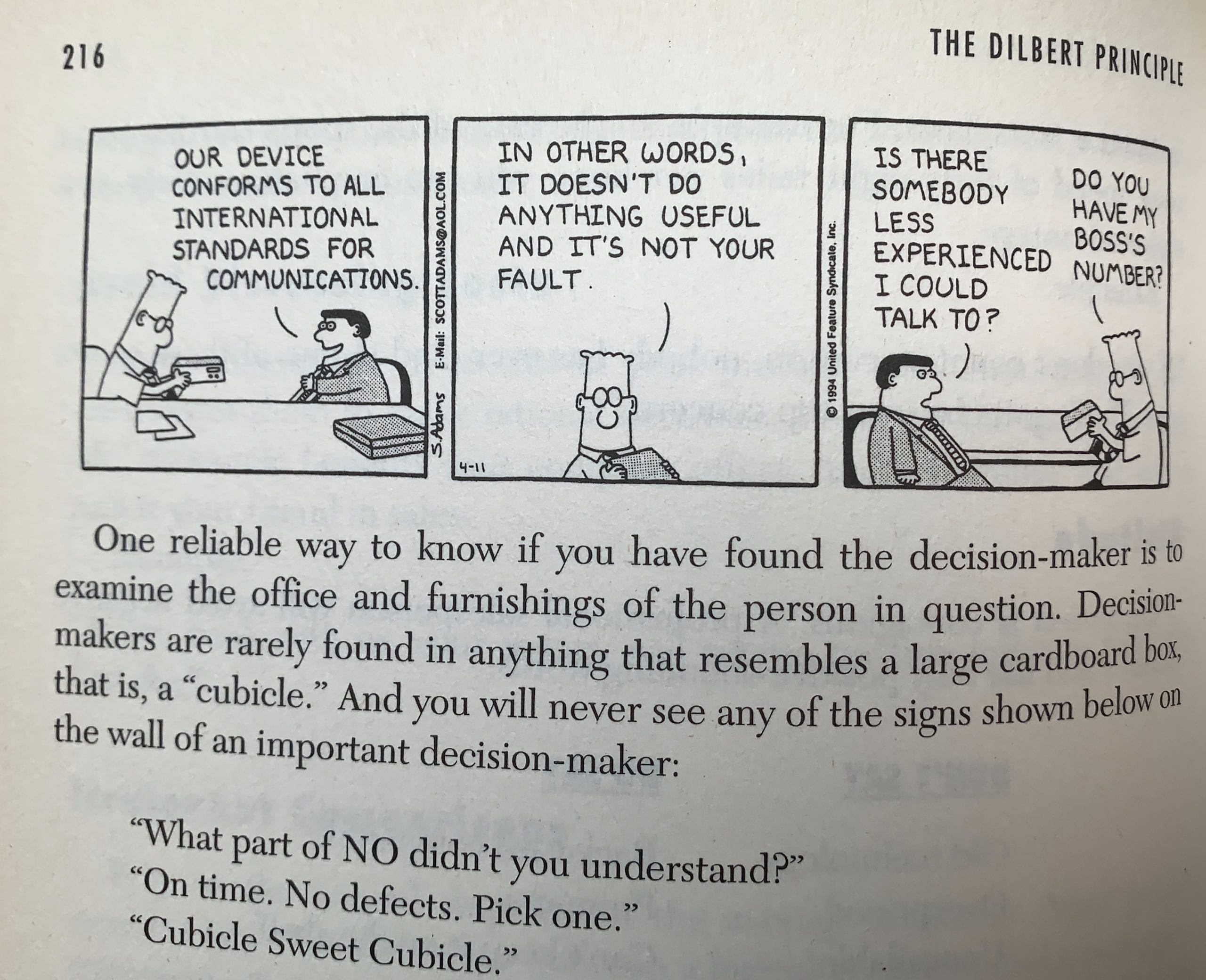
Beitragsfoto: Dilbert Comic

Scott Adams

Wenn ich ein Vorbild in Sachen Projektmanagement hatte, dann sicherlich diesen Pacific Bell-Angestellten, dessen Karriere ich von Anfang an bis hin zur Stunde des Wiesels mitverfolgte. Zum Schluss wurde er etwas wunderlich und entwickelte sich später sogar zum Rassisten. Er hatte wohl viel zu früh Abstand von der Realität genommen.

Richard Sandomir schrieb in der New York Times den hier verlinkten Nachruf auf Dilbert.

„The title character was a frustrated engineer working from a cubicle at a high-tech company whose intelligent, anthropomorphic pet, Dogbert, dreamed of world domination.“

Richard Sandomir, 13.1.2026

Mir bleiben seine ersten Bücher und seine Comic-Strips in guter Erinnerung, die auch heute noch sehr lehrreich sind, wenn man nicht gerade die Weltherrschaft anstrebt.

Basteln

Gestern konnte ich zwischen zwei Veranstaltungen ein wenig basteln, besser ausgedrückt, ich habe basteln lassen. Detlef Stern hat ein neues Spielzeug und ich wollte das auch einmal haben. Früher™ hat man einfach seine Autos kurz getauscht, heute in der digitalen Welt bekommt man einen eigenen Zugang zur entsprechenden Software. Und damit hat dann das Basteln erst so richtig begonnen.

Ob ich dann auch einmal zum Spielen komme, wird sich in den kommenden Tagen herausstellen. Und weil ich kurz darauf dann völlig den Überblick verlor — das mit Kennwörtern und Zugangscodes war noch nie mein Ding! — habe ich ein wenig DS9 gebingt. Was mich dabei immer wieder fasziniert, wo die Protagonisten die notwendige Energie für ihre Spielzeuge herbekommen.

Detlef Stern und ich bekommen spätestens mit der nächsten Stromabrechnung den Hinweis darauf, wo unsere Energie so alles herkommt.

Vermischtes

Höhepunkt des gestrigen Tages war ein gut besuchter Europastammtisch. Demnächst werde ich darüber auf der EUROPA-UNION Website berichten.

Beim Stöbern durch meine Blogroll bin ich auf einen Beitrag von Addy Osmani gestoßen, den ich allen Machern nur empfehlen kann. Schon alleine sein Titel ist sehr vielversprechend „21 Lessons From 14 Years at Google“. Seine 17. Lehre unterschreibe ich ohne Wenn und Aber — wobei ich sie selbst nie befolgt habe.

Gestern konnte ich auch meine Vorlesung für dieses Semester abschließen. Es bestand mehr als genug Zeit und Gelegenheit, um mir während des Semesters Fragen zu stellen oder gar ein paar der gestellten „Hausaufgaben“ zu erledigen. Wohl der Zeit geschuldet, kommen nun die ersten in den Vorlesungen nicht anwesenden Studenten mit Fragen um die Ecke. Es hat bei mir den Anschein, als ob man als Edelstudent das Gemeinschaftserlebnis Vorlesung meidet, dafür aber auf Einzelunterrichtung durch den Dozenten besteht, möglichst noch zum gerade für den Studenten passenden Zeitpunkt. Würde mich auch nicht mehr wundern, wenn sie demnächst die Herausgabe von „Leitungslösungen“ für die Klausur fordern.

Der olympische Gedanke war vielleicht schon immer reine Fiktion. Was die Verantwortlichen sich heute aber leisten, kann nicht einmal mehr von den kriminellsten Zeitgenossen übertroffen werden. Inzwischen werden die olympischen Spiele an Massenmörder und Kinderschänder verkauft, diesen zumindest aber die beste Publicity garantiert — Hauptsache die Organisatoren können sich selbst bereichern!

Das Schlimme daran ist es aber, dass die ganze Welt dabei mitmacht und diesen Verbrechern die Steuer- und Sponsorenmilliarden nur so in den Hintern schiebt.

Post Scriptum

https://yoyod.de/@kuemmerle


Lesezeichen

Will Europe Wag Its Tail? 5 (1)

Beitragsfoto: Lesezeichen | © kertlis von Getty Images

Jean Marsia | Visegrad Insight

Trump and Putin Call the Shots. Will Europe Wag Its Tail? – OPINION (zuletzt aufgerufen am 31.10.2025, 17.00 Uhr)

Jean Marsia schreibt in einem Gastbeitrag das Folgende:

„Why we must pull ourselves together – now.

Europeans have been far too polite for far too long. At Turnberry, Ursula von der Leyen played the courteous guest while Donald Trump slapped on tariffs and pocketed promises of energy and arms contracts. Washington and Moscow now chat over Ukraine’s fate as if Europe is a side dish. Our only escape is a Federation that can say no, spend smart and act like a power rather than a pawn.

Russian fighter jets and drones have violated the airspace of European states with increasing frequency this summer. These incidents raise the question of whether the European Union (EU) and the North Atlantic Treaty Organisation (NATO) can deal with the intensification of the hybrid war that Vladimir Putin, Russia’s president, has been waging against us since 2007. He is no longer content with manipulating public opinion and disrupting electoral and decision-making processes; he is testing the military capabilities of European NATO countries. ‘We are not at war, but we are no longer at peace either’, said the German Chancellor Friedrich Merz in Düsseldorf on 29 September 2025.

Yet, Europe’s impotence and lack of relevance are evident everywhere: from our eastern flank to the Mediterranean to the Israel-Palestine conflict. Europe was also absent during the signing of the peace agreements between Rwanda and the Democratic Republic of Congo, as well as between Armenia and Azerbaijan, at the White House. The only exception to this is Ursula von der Leyen’s support of Ukraine at the Washington summit, alongside five European leaders.

Failure to recognise the realities across two dimensions – geopolitical and economic – has humiliated the leaders of the ‘core’ EU member states and the European Commission (EC) in particular, harming Europeans and European exporters in particular, in the process.

The monkey on our back

Our primary weakness is our inability to build a fully independent and resilient defence posture since Russia’s first hybrid attacks on Europe in 2007. The war in Ukraine has further exposed how much Europe’s defence depends on the United States (US), even though the share of its overall defence spending allocated to the protection of Europe is very small, ranging between four and 15 per cent. The recent Interim National Defence Strategic Guidance document reveals that the US is more concerned with the potential conflict with the People’s Republic of China (PRC) over the fate of Taiwan. It is thus a big question whether the US would ensure full nuclear deterrence to Europe and comply with NATO’s Article V in the event of a Russian attack.

The rhetoric at this June’s NATO summit in The Hague confirmed the fears. The allies agreed to US President Donald Trump’s request to allocate five per cent of their GDP to their security and defence.

A storm brewing on the horizon

This, however, will not deter Putin from testing the strength of the Atlantic Alliance in the years to come, because the rise in our defence spending mainly increases the waste and boosts imports of American systems, which harms our economy. According to several European intelligence services, if Putin were to be victorious in Ukraine, he would then proceed with annexing Transnistria, Moldova and Belarus before eventually cutting off the Baltic states from Europe.

Russia is testing our defences a little more every day. On the night of 10 September 2025, at least 19 Russian drones entered Polish airspace. Only three were shot down, which shows the weakness of Europe’s air and missile defences. Poland requested the activation of Article IV of the NATO Treaty, which provides for consultations between allies in the event of a threat to one of its members, rather than Article V, which Ukraine considered a sign of weakness

Other, more ambitious scenarios are also possible. In his book ‘Who Will Defend Europe? An Awakened Russia and a Sleeping Continent’, Keir Giles describes a children’s map found for sale in Moscow, which shows the ‘Russian motherland’ as including much of Eastern Europe – Ukraine, Belarus, the Baltic states, Central Asia, and even parts of Poland and Finland. Putin has repeatedly stated that he aims to restore Russia’s zone of influence, which was previously part of the Soviet Union.

It’s the economy, stupid

The second factor of weakness is that of our economy. A year after the September 2024 report on European competitiveness by Mario Draghi, former president of the European Central Bank, which warned of the economic stall vis-à-vis the US and China, and which formulated 170 proposals to revive Europe, only ten per cent of these have been implemented.

Like Draghi, let us note that the EU’s economic weight does not give it geopolitical power, despite its 450 million consumers. The EU, once described as a geopolitical dwarf but an economic giant, is now nothing more than a giant with feet of clay.

A Europe flouted

At the G7 summit, held in Canada, from 15 to 17 June 2025, the leaders of the main EU member states and Trump clashed over Ukraine and a minimum tax on the profits of US multinationals.

Shortly after, Europe suffered its first unequal treaty, akin to the Treaty of Nanking inflicted on China in 1842. Unlike in the 19th century China, however, von der Leyen met Donald Trump freely at Turnberry, Scotland, on 27 July to appease him and to protect the EU’s largest exporters, Germany and Italy. She disdained our will for strategic autonomy and for fighting against climate change, instead accepting a 15 per cent increase in customs duties on European exports and a removal of such on imports from the US.

Von der Leyen also gave up on taxing its digital services sector. She did not activate the anti-coercion instrument, which would have allowed us to penalise our ‘allies’ across the Atlantic. Without having the slightest competence, mandate or budget to do so, Ursula von der Leyen pledged to invest 600 billion US dollars in America, to buy 750 billion dollars worth of hydrocarbons in three years and ‘hundreds’, according to Donald Trump, of billions of dollars in armaments.

The new paper tiger

The arguments used by the president of the EC to justify her position in Turnberry were the stability and predictability of our transatlantic trade. Yet, both lost their relevance within a few weeks. Donald Trump threatens new tariffs on the EU if it dares to tax American digital services and/or dismantle its regulations in this area.

On 5 September 2025, the EC fined Google 2.95 billion euros for violating European competition rules with its advertising technologies. The Commission has ruled that since 2014, ‘Google has acted to favour its own online display advertising technology services to the detriment of competing advertising technology service providers, advertisers and online publishers’. The EC has ordered the company to end its self-referencing practices and to end its conflicts of interest in the context of advertising technology. At the time of writing, Google still has time to inform Brussels of the remedies it would propose.

Nevertheless, the EC should have directly confronted the Trump administration, which only understands the balance of power, even if it meant enduring a few difficult weeks. This is what China has done, with success. It is to be hoped that the European Parliament will refuse to implement this unequal Turnberry agreement as it stands. Immediately after von der Leyen’s State of the Union address, many from the liberal/centrist (Renew), social-democratic (S&D), and green (Greens) political groups in the European Parliament spoke out in this vein, as did the representatives of the more left- and right-wing groups in the hemicycle.

A Europe ignored, then robbed

During the meeting between Trump and Putin near Anchorage, Alaska, on 15 August, the Russian dictator, who has since been particularly ungrateful, was welcomed on the red carpet and with demonstrations of friendship. Continental Europeans have been treated as if they were at Yalta: the future of the conflict in Ukraine is envisaged without them, and the partition of Ukraine that is being prepared resembles that of Germany in 1945.

On 18 August, a delegation of heads of state and government escorted Volodymyr Zelensky to the White House. The exaggerated flattery of the Europeans and the spectacle staged for American television channels, in which Donald Trump behaved like an emperor receiving his vassals, has made teeth grind. In exchange, the Europeans only obtained vague promises from Donald Trump of American support for the troops they could deploy on the ground after a ceasefire in Ukraine. The bill is heavy: military aid to Kyiv, totalling nearly 100 billion euros of American armaments, will be entirely at the expense of the Europeans, who will also have to pay a 10 per cent surcharge!

Perilous future ahead

Since the year 2000, our leaders have clearly taken Europe out of the group of powers that make history. Its marginalisation is patent: fragmented, sparsely populated, because Europeans make up only 5 per cent of the world’s population, its economy is lagging behind the US and China. Under these conditions, Europe’s strategic autonomy is a chimaera. Never before has the fact that Europe is not yet a Federation cost us so much.

By vassalising us, policymakers prevent Europeans from mastering our destiny. They put us at risk of recession and aggression. Their disunity and the lack of a credible European defence make them almost insignificant on the international stage, even in trade matters. Europe is nothing more than a prey for the imperialist powers that seek to dominate the world and destabilise our democracies, particularly by interfering in our electoral processes.

The USA, under Trump, is no longer reliable

Europeans, even those who had blind and long faith in NATO, are gradually waking up to the risk posed by the second Trump administration. It is not fulfilling its obligations under the 1994 Budapest Memorandum, by which the Americans, and others, including Russia, ‘guaranteed’ Ukraine’s territorial integrity. The Administration may decide to relinquish its duties under the North Atlantic Treaty and withdraw US forces from the European continent, just as it happened in Afghanistan, because it shows deep contempt for its long-standing allies, both in Europe and in the Indo-Pacific.

The US is risking losing its allies and having to face in isolation a bloc that challenges its hegemony, composed at least of China, Russia, Iran and North Korea, but which will undoubtedly be much larger, because China has woven a global network. It has become unreasonable to rely on NATO, that is, on the US, led by Donald Trump, especially since the Alliance has failed for seventy-five years to make the defence spending of European states more efficient.

The looming threat of China

The EU’s trade deficit with China has doubled in five years. After flooding our markets with consumer goods and plundering our technologies, it is overtaking Europe in terms of innovation. Products that will no longer find a market in the US will be offered to us at low prices, and we will be obliged to buy them, because we absolutely need rare earths – materials that are essential for many advanced technologies, the production of which is now de facto monopolised by China.

Don’t get lost in a cul-de-sac!

Despite having 1.5 million active military personnel and high-performing defence industries, which would be enough to build a force capable of deterring any possible aggressor, European political leaders only propose submission to America, at a high price.

Nearly half of the aeroplanes, missiles and armoured vehicles that equip armies in Europe come from across the Atlantic. Others come from South Korea, Brazil, Israel or Turkey. This is because these politicians generally consider only their personal and partisan interests in the short term. Some, more altruistic or more sensitive to lobbying, take their national interests into account. In the middle powers, the most ambitious dream is to lead inside Europe. Those who care about the interests of Europeans can be counted on the fingers of one hand. The lack of real unity is evident at every meeting of European leaders; the family photo is deceptive.

In its current institutional configuration, Europe is not in a position to put in place effective diplomacy and deterrence. This should include a complete and legitimate politico-military chain of command, as well as an autonomous intelligence service. It would be foolish to follow certain European politicians and diplomats who want to commit us once again to the path of an intergovernmental ‘European’ defence, because they reject the federation announced on 9 May 1950 by Robert Schuman.

These irresponsible people seem confused enough to draft a European Defence Union on the basis of various provisions of the treaties and EU law, which would require a very unlikely, unanimous decision by the European Council to enter into force. Europe, if it proves them right, would once again take the path that, since 1954, has repeatedly proven to be a dead end.

What must be done after Copenhagen

EU leaders met on 1 October in Copenhagen to discuss how to strengthen Europe’s common defence, governance and support for Ukraine. They are unaware of the urgency, as they have set 2030 as their deadline. It seems doubtful that Putin would wait until he is seventy-eight years old to act.

The president of the EC would like Europe to be able to detect foreign incursions and intercept threats, ranging from simple jamming to the destruction of drones. She proposed to task the EU to set up an anti-drone wall, an eastern-flank surveillance network, an air-defence shield and a space-defence shield. In response, France, Italy and Germany recalled that she has no competence in the field of defence: this task falls to NATO, not the EU – which is currently unable to even agree on who is responsible for Europe’s military build-up, the financing of Ukraine’s resistance and its accession to the EU.

The very high number of participants in EU meetings obviously does not help to put the European common good before the interests of the member states. Yet this would be essential for Europe to exist geopolitically in an increasingly hostile world.

Time will show who is the real paper tiger

On 2 October, Putin accused the Europeans of fuelling the ‘conflict’ in Ukraine, preventing its resolution and promoting constant escalation, saying he was also attentive to the militarisation of Europe. He said he does not accept Germany’s assertion that its army should once again be the most powerful in Europe. On 7 October, Putin refused to compromise to end the war, although he occupies only 19.05 per cent of Ukraine; Ukraine has lost only 0.53 per cent of its territory in 2025.

Still, NATO believes that it is ready to defend itself against future Russian incursions involving missiles, aircraft or any other means, but is this true? According to Ben Hodges, former commander of the US Army in Europe, NATO is not prepared to deal with daily strikes by hundreds of Russian drones. In July, NATO’s secretary general estimated that the Alliance must quadruple its air and missile defences. Since NATO member states decide individually on their acquisitions, how will the new systems be integrated into a common defence?

Decades of rejection of the federation of Europe and neglect of defence explain why we have sunk so low. This must be fixed before it’s too late. Let us hope that a new generation of statesmen and women will pull us out of the disaster we are facing.

Federalisation is the recipe for Europe’s strategic autonomy

Our strategic autonomy cannot be achieved through NATO-type cooperation, or through EU integration, or through a confederation, because the latter either turns into a federation or dissolves.

The Swiss Confederation, founded in 1291, became a federal government in 1848 after the Sonderbund Civil War. In Federalist Paper No. 20, of 11 December 1787, James Madison described the calamitous confederal organisation of the seven ‘United Provinces’ of the Northern Netherlands in the 18th century. The United States of America replaced the Articles of Confederation of 1776 with the federal constitution of 1787, having experienced inadequate governance during the War of Independence. Germany became a federal state in 1949, having finally learned the lessons of its past. As for the Commonwealth of Independent States, conceived by Mikhail Gorbachev in 1990 to succeed the Union of Soviet Socialist Republics, it very quickly malfunctioned and then collapsed.

Only a federation could give us strategic autonomy.

By federating, Europe could still change the course of history. It would cease to be the vassal of the US, and it would empower us to command respect from China. Thus, a vanguard of willing member states should launch a federal core encompassing foreign policy, defence, migration and taxation.

Looking ahead

The indignation of European citizens in Ursula von der Leyen’s position in Turnberry should lead to a movement towards a federal Europe, so that Europe can exist geopolitically in an increasingly hostile world. Some states, members of the EU and NATO, could start to put an end to the vassalisation of Europe. As with the Schengen area or the eurozone, this coalition of willing states would expand. Such a European state, governed by a federal constitution, should put an end to the duplication of military capabilities that mobilise resources that could be pooled to fill our defence gaps. This requires the drafting and adoption of a federal constitution by an elected European Assembly, which could be composed of certain members of the European Parliament*.

* The European Society for Defence INPA (S€D) continues its efforts to identify and support the first government to be persuaded to initiate the federative process.”


Jean Marsia schrieb bereits hier als Gastblogger und ist zudem jahrelanger Teilnehmer der Hertensteiner Gespräche. Er ist meinungsstark und streitbar.