ALF mit Familie

Alien Life Form 5 (3)

Beitragsfoto: ALF mit Familie | © Warner

Meine Entscheidung steht, anstatt der aktuellen Komödie um den CDU Vorsitz zu folgen, habe ich mich dazu durchgerungen, die vier Staffeln von ALF anzuschauen und hoffe, dass danach feststeht, wer CDU Vorsitzender und was aus ALF geworden ist.

Von 1986 bis 1990, also noch in der Vor-Merkel-Ära, wurde vom Sender NBC in vier Staffeln 102 Folgen von ALF ausgestrahlt. Die ersten Folgen konnte ich anfangs noch im ZDF schauen, dann aber wurde die Zeit für solche Unterhaltungen zu knapp, obwohl jede Folge kaum 25 Minuten dauert.

ALF ist das Alphatier der Serie und erkennt ebenfalls weder Nebenbuhler an, noch sorgt er für eine adäquate Nachbesetzung seiner Rolle als Fremdkörper in einer Durchschnittsfamilie.

„If you love something, let it go. If it comes back to you, it’s yours. If it’s run over by a car, you don’t want it.“

ALF

Mir war ALF von Anfang an sympathisch, weil wir nicht nur zu Katzen ein ähnliches Verhältnis haben, sondern auch in unseren Bemühungen die Welt zu retten ähnlich erfolgreich sind.

Zudem weckte er gute Erinnerungen an „Mein Onkel vom Mars“ aus den Jahren 1963 bis 1966 und „Mork vom Ork“ aus den Jahren 1978 bis 1982, die ich noch als Schüler gesehen hatte und die erstaunlicher Weise ebenfalls ihre Pendanten in der Tagespolitik kannten.

„Like my old skeelball coach used to say: ‚Find something you’re not good at, and then don’t do it.‘“

ALF

Wer ALF nicht kennt, darf sich von seinem Kuscheltieräußeren nicht blenden lassen, denn in ihm steckt mehr Intelligenz als in seiner gesamten Umgebung, eine kaum sonst noch vorhandene Durchsetzungsstärke und das nötige Quantum von ganz normalen Wahnsinn, was ihn letztendlich auch zum Menschen macht.

„Putting humans in charge of the earth, is the cosmic equivalence of letting Eddie Murphy direct.“

ALF

Und schon damals galt, wer vier Staffeln schafft, gehört automatisch zum Inventar. Dumm nur, dass damit verbunden kaum einer mehr weiß, was aus ihm letztendlich geworden ist und welchen Zweck er erfüllte: das mit dem Katzenschreck ging bekannter Weise schief, und Mäuse, die auf den Tischen tanzen, gibt es nur im echten Leben.

„Are you gonna throw a hissy fit every time I squander a couple thousand dollars?“

ALF

Sandstrand

Sprichwörter 5 (11)

Beitragsfoto: Sandstrand | © Pixabay

Beim Ausmisten von alten Websites bin ich jüngst auf eine Sammlung von Sprichwörtern gestoßen, die ich über Jahre hinweg selbst gesammelt habe und dann doch nicht gleich ins digitale Nirvana schicken wollte. So habe ich Teile davon in diesen Beitrag hinübergerettet und gucke jetzt mal, ob es dafür auch Liebhaber gibt.

  1. Measure a thousand times and cut once. (Turkish)
  2. Who begins too much accomplishes little. (German)
  3. Actions speak louder than words. (English)
  4. Never advise anyone to go to war or to marry. (Spanish)
  5. Aim high in your career but stay humble in your heart. (Korean)
  6. Man kann nicht alles haben, z.B. eine dicke Frau und Platz im Bett. (Swabian)
  7. The best answer comes from the man who isn’t angry. (Arabian)
  8. Der Apfel fällt nicht weit vom Stamm. (Yiddish)
  9. It is better to fake a good attitude rather than having a sincere bad one. (American)
  10. Morgenstund hat Gold im Mund. (German) / Aurora musis amica. / Aurora habet aurum in ore. (Latin)
  11. A baby on its mother’s back does not know the way is long. (African)
  12. Bad habits are easier to abandon today than tomorrow. (Yiddish)
  13. The spider and the fly can’t make a bargain. (Jamaican)     
  14. Don’t bark if you can’t bite. (French)
  15. Beauty without virtue is like a rose without scent. (Swedish)
  16. Schönheit vergeht, Tugend besteht. (German)
  17. Schönheit vergeht, Hektar besteht. (Swabian)
  18. A beautiful thing is never perfect. (Egyptian)
  19. Bier macht den Durst erst schön. (German)
  20. Beggars can’t be choosers. (English)
  21. Gold cannot be pure, and people cannot be perfect. (Chinese)
  22. Two wrongs don’t make a right. (English)
  23. If you believe everything you read, better not read. (Japanese)
  24. Speak softly and carry a big stick; you will go far. (West African)
  25. Kila ndege huruka kwa bawa lake. (Swahili) / Jeder Vogel fliegt mit seinen eigenen Flügeln. (German)
  26. Blood is thicker than water. (English)
  27. The fallen blossom doesn’t return to the branch. (Japanese)
  28. You can’t judge a book by its cover. (English)
  29. A book is like a garden carried in the pocket. (Arabian)
  30. With the mouth, one can ford the wildest river. (Ethiopian)
  31. Don’t cross your bridges until you come to them. (American)
  32. No man can paddle two canoes at the same time. (Bantu)
  33. The cask can only yield the wine it contains. (Italian)
  34. There’s more than one way to skin a cat. (English)
    [ALF: “You’ve been looking at my recipe book.”]
  35. A large chair does not make a king. (Sudanese)
  36. Don’t count your chickens before they hatch. (English)
  37. It takes a whole village to raise a child. (African)
  38. A beloved child has many names. (Finnish)
  39. Do not choose for anyone what you do not choose for yourself. (Persian)
  40. A clear conscience is a soft pillow. (German)
  41. A courtyard common to all will be swept by none. (Chinese)
  42. The girl who can’t dance says the band can’t play. (Yiddish)
  43. Every man knows that he must die, but no one believes it. (Yiddish)
  44. Those whom the gods love die young. (Greek)
  45. No one tests the depth of a river with both feet. (African)
  46. If you think you are too small to make a difference, you haven’t spent a night with a mosquito. (African)
  47. All things are difficult before they are easy. (Chinese)
  48. Viel Würden, viel Bürden.  / Keine Würde ohne Bürde. (German)
  49. Dreck schwimmt immer oben. (German)
    [Joachim Rachel: „O dieser Dreck schwimmt oben!“ (Der Poet)]
  50. The person who says it cannot be done should not interrupt the person doing it. (Chinese)
  51. If you want something done right, you have to do it yourself. (English)
  52. Am Abend wird der Faule fleißig. (German)
  53. Duty knows no family. (Japanese)
  54. The early bird gets the worm. (German)
  55. The only easy day was yesterday. (US Navy SEALs)
  56. Easy come, easy go. (English) / Wie gewonnen, so zerronnen. (German)
  57. He who eats moderately will never need doctors. (Japanese)
  58. All’s well that ends well. (English)
  59. The enemy of my enemy is my friend. (Arabian)
  60. No enemies is a sign that fortune has forgotten you. (Turkish)
  61. When there is no enemy within, the enemies outside cannot hurt you. (African)
  62. It is better to be envious than to have pity. (French)
    [Voltaire’s Philosophical Dictionary]
  63. Everyone is kneaded out of the same dough, but not baked in the same oven. (Yiddish)
  64. Examine what is said, not him who speaks. (Arabian)
  65. Fall seven times and stand up eight. (Japanese)
  66. Don’t fall before you’re pushed. (English)
  67. Be not afraid of going slowly, be afraid only of standing still. (Chinese)
  68. Angst essen Seele auf. (German)
  69. Fear less, hope more; eat less, chew more; whine less, breathe more; talk less, say more; hate less, love more; and all good things are yours. (Swedish)
  70. Die Fichte sticht, die Tanne nicht. (German)
  71. The older the fiddle, the sweeter the tune. (Irish)
  72. Flies never visit an egg that has no crack. (Chinese)
  73. Gleich und Gleich gesellt sich gern. (German) / Birds of a feather flock together. (English)
  74. A fool dreams of wealth, a wise man, of happiness. (Kurdish)
  75. Fooled once shame on you, fooled twice shame on me. (American)
  76. Dem Glücklichen schlägt keine Stunde. (German)
    [„O! Der ist aus dem Himmel schon gefallen, der an der Stunden Wechsel denken muß, die Uhr schlägt keinem Glücklichen.“ (Friedrich Schiller, Wallensteins Lager]
  77. If you want a friend, be a friend. (English)
  78. There is more friendship in a half pint of whiskey than in a churn of buttermilk. (Irish)
  79. A friend to everybody is a friend to nobody. (Chinese)
  80. A friend is known when needed. (Saudi)
  81. Once the game is over, the king and the pawn go back in the same box. (Italian)
  82. A generous person will prosper; whoever refreshes others will be refreshed. (Sprüche Salomos, 11:25)
  83. Was stört es eine deutsche Eiche, wenn sich die Sau dran kratzt. (German)
  84. What does a monkey know of the taste of ginger? (Hindi)
  85. When you have given nothing, ask for nothing. (Albanian)
  86. If God does not grant you glory, be content with fame. (Brazilian)
  87. One God and so many enemies. (Yiddish)
  88. Do good and throw it in the sea. (Arab)
  89. No good deed goes unpunished. (American)
  90. Remember even when you loose all, keep your good name; for if you loose that you are worthless. (Irish)
  91. Whoever gossips to you will gossip about you. (Spanish)
  92. The believer is happy; The doubter is wise. (Hungarian)
  93. What was hard to bear is sweet to remember. (Indian)
  94. Your health comes first; you can always hang yourself later. (Yiddish)
  95. Health is better than wealth. (Irish)
  96. Sei immer froh und heiter wie der Frosch auf seiner Leiter. (German)
  97. L’enfer est plein de bonnes volontés ou désirs. (French) / Facilis descensus Averno. (Latin) / Der Weg zur Hölle ist mit guten Vorsätzen gepflastert. (German)
  98. Hope is the last thing ever lost. (Italian)
  99. Noli equi dentes inspicere donati. (Latin) / Einem geschenkten Gaul schaut man nicht ins Maul. (German)
  100. You can lead a horse to water, but you can’t make it drink. (English)
  101. If you sit in a hot bath, you think the whole town is warm. (Yiddish)
  102. He who would go a hundred miles should consider ninety-nine as halfway. (Japanese)
  103. Hunger is the best cook. (German)
  104. A good husband is healthy and absent. (Japanese)
  105. Quod licet Iovi, non licet bovi. (Latin)
  106. One joy scatters a hundred griefs. (Chinese)
  107. O Great spirit, keep me from ever judging and criticizing a man until I have walked in his moccasins for two weeks. (Sioux)
  108. Everyone loves justice in the affairs of another. (Italian)
  109. Ist die Katze aus dem Haus, tanzen die Mäuse auf dem Dach. (German)
  110. He who eats last is king. (African)
  111. Hält man sich für klein, wird man auf den Kopf getreten. (Jewish)
  112. What one knows it is sometimes useful to forget. (Latin)
  113. The more you know, the less you need. (Aboriginal)
  114. A wise man never knows all, only fools know everything. (African)
  115. It is better to conceal one’s knowledge than to reveal one’s ignorance. (Spanish)
  116. Eine Krähe hackt der anderen kein Auge aus. (German)
  117. Der Krug geht so lange zum Brunnen, bis er bricht. (German)
  118. Our last garment is made without pockets. (Italian)
  119. When the mouse laughs at the cat, there is a hole nearby. (Nigerian)
  120. Laughter is an instant vacation. (American)
  121. Wer zuletzt lacht, lacht am besten. (German)
  122. With lies you may get ahead in the world – but you can never go back. (Russian)
  123. Lügen haben kurze Beine. (German)
  124. Life is a big headache on a noisy street. (Yiddish)
  125. Das Leben meistert man lächelnd oder gar nicht. (Chinese)
  126. Mit jedem Tag des Lebens kommt ein Stück Weisheit hinzu. (Vietnamese)
  127. Memento mori. (Latin)
  128. He who does not wish for little things does not deserve big things. (Belgian) / Wer den Pfennig nicht ehrt, ist des Thalers nicht wert. (German)
  129. The secret to living well and longer is: eat half, walk double, laugh triple, and love without mesure. (Tibetian)
  130. To get lost is to learn the way. (African)
  131. Akipenda, chongo huita kengeza. (Swahili) / Liebe macht blind. (German)
  132. Love disregards all inequalities and differences in social status. (Japanese)
  133. One who marries for love alone will have bad days but good nights. (Egypt)
  134. Good luck comes in tricklets; ill luck comes in torrents. (Irish)
  135. There’s no such thing as a free lunch. (English)
  136. If you want to be criticized, marry. (Irish)
  137. Send a wise man and don’t advise him. (Arabian)
  138. The rich have money, the poor have children. (Swedish)
  139. The morning hour has gold in its mouth. (German)
  140. God could not be everywhere and therefore he made mothers. (Hebrew)
  141. Ein Nagel, der herausragt, muss eingeschlagen werden. (Japanese)
  142. Nanos gigantum humeris insidentes (Latin) / I say with Didacus Stella, a dwarf standing on the shoulders of a giant may see farther than a giant himself. [Robert Burton, 1621] / If I have seen further, it is by standing on the shoulders of giants. (Isaac Newton)
  143. A narrow place can contain a thousand friends. (Syrian)
  144. Gute Nachbarn sind ein echter Schutz. (Hungarian)
  145. Wer gute Nachbarn hat, bekommt einen guten Morgen. (German)
  146. Choose the neighbor before the house. (Syrian)
  147. No news is good news. (English)
  148. The night rinses what the day has soaped. (Swiss)
  149. There is nothing noble about being superior to some other man. The true nobility is in being superior to your previous self. (Hindu)
  150. Don’t throw away the old bucket until you know whether the new one holds water. (Swedish)
  151. You can’t teach an old dog new tricks. (English)
  152. Eine Palme wächst nicht schneller, wenn man an ihr zieht. (Egypt)
  153. Patience can conquer destiny. (Irish)
  154. Nobody ever bought peace but the man who hadn’t got it. (Irish)
  155. The cemeteries are filled with people who thought the world couldn’t get along without them. (American)
  156. Das Bessere ist ein Feind des Guten. (German) / Il meglio è nemico del bene. (Italian) / Le mieux est l`ennemi du bien. (French)
    [Voltaire, La Bégueule – Conte mora]
  157. Zwischen Leber und Milz paßt immer noch ein Pils. (German)
  158. He who pays the piper calls the tune. (Irish) / Wes’ Brot ich ess’, des’ Lied ich sing. (German)
  159. Der Mentsh trakht un Got lakht. (Yiddish)
  160. If you must play, decide on three things at the start: the rules of the game, the stakes, and the quitting time. (Chinese)
  161. What belongs to everybody belongs to nobody. (Spanish)
  162. The surest way to remain poor is to be an honest man. (French)
  163. Practice is the best master. (Latin)
  164. There is only one pretty child in the world and every mother has it. (Chinese)
  165. Eigentum verpflichtet. Sein Gebrauch soll zugleich Dienst sein für das Gemeine Beste. (Article 153 (3) of German Constitution in 1919)
  166. Eigentum verpflichtet. Sein Gebrauch soll zugleich dem Wohle der Allgemeinheit dienen. (Grundgesetzes, Artikel 14 (2) 1949)
  167. Public money is like holy water; people help themselves. (Italian)
  168. Regen lässt das Gras wachsen, Wein das Gespräch. (Swedish)
  169. Only your real friends will tell you when your face is dirty. (Sicilian)
  170. Keine Arme, keine Kekse. (German)
  171. When eating fruit, remember who planted the tree; when drinking clear water, remember who dug the well. (Vietnamese)
  172. Ist der Ruf erst ruiniert, lebt es sich ganz ungeniert. (German)
  173. Rest breeds rust. (German)
  174. It is not enough for a man to know how to ride; he must know how to fall. (Irish)
  175. When in Rome, do as the Romans. (English) / Follow the villagers when you are in the new village. (Japanese)
  176. Tous chemins vont à Rome. (French)
    [Jean de La Fontaine]
  177. Sad are only those who understand. (Arabian)
  178. A scholar’s ink lasts longer than a martyr’s blood. (Irish)
  179. Am Baume des Schweigens hängt seine Frucht der Friede. (Arabian)
  180. You can’t steal second base with your foot on first. (American)
  181. Sex is marvellous, but Christmas is more often. (Catholic)
  182. More than three shakes is a wank. (Australian)
  183. Don’t break your shin on a stool that is not in your way. (Irish)
  184. The smarter you get the less you speak. (Arabian)
  185. Wo Rauch ist, ist auch Feuer. (German)
  186. No snowflake ever falls in the wrong place. (Chinese)
  187. Mach es wie die Sonnenuhr, zähl die heitren Stunden nur. (German)
  188. If it were ever to rain soup, the poor would only have forks. (Brazilian)
  189. Raum ist in der kleinsten Hütte für ein glücklich liebend Paar. (German)
    [Friedrich Schiller, Der Parasit, oder die Kunst, sein Glück zu machen]
  190. Capta avis est melior, quam mille in gramine ruris. (Latin) / Ein Spatz in der Hand ist besser als eine Taube auf dem Dach. (German) / A bird in the hand is worth two in the bush. (English)
  191. Reden ist Silber, schweigen ist Gold. (German)
  192. When you have spoken the word, it reigns over you. When it is unspoken you reign over it. (Arabian)
  193. Four things come not back. The spoken word, the sped arrow, the past life, and the neglected opportunity. (Arabian)
  194. Starting is half the task. (Korean)
  195. Don’t stay long when the husband is not at home. (Japanese)
  196. If you buy what you don’t need, you steal from yourself. (Swedish)
  197. Saxum volutum non obducitur musco. (Latin) / A rolling stone gathers no moss. (English)
  198. You do not stumble over a mountain, but you do over a stone. (Indian)
  199. Never underestimate the power of stupid people in large numbers. (Ugandan)
  200. As a dog goes back to its vomit, so a fool repeats his stupidity. (Sprüche Salomos, 26:11)
  201. Never give a child a sword. (Latin)
  202. God grant me a good sword and no use for it. (Polish)
  203. Even a fool has one talent. (Japanese)
  204. Dead men tell no tales. (English)
  205. Tränen sind wie Perlen. Man weiß nie, ob sie echt sind. (Indonesian)
  206. Tension is who you think you should be. Relaxation is who you are. (Chinese)
  207. The big thieves hang the little ones. (Czech)
  208. Dig your well before you’re thirsty. (Hindu)
  209. Spare in der Zeit, so hast Du in der Not. (German)
  210. One man’s trash is another man’s treasure. (English)
  211. A day of traveling will bring a basketful of learning. (Vietnamese)
  212. If you want to go fast, go alone. If you want to go far, go together. (African)
  213. The ugly wife is a treasure at home. (Chinese)
  214. When an elephant is in trouble even a frog will kick him. (Hindu)
  215. Vertrauen ist gut, Kontrolle ist besser! (German) / Vertraue, aber prüfe nach. (Russian)
  216. Speak the truth, but leave immediately after. (Slovenian) / Wer die Wahrheit sagt, braucht ein schnelles Pferd. (Chinese)
  217. Truth is the safest lie. (Jewish)
  218. Having two ears and one tongue, we should listen twice as much as we speak. (Turkish)
  219. Vision without action is a daydream. Action without vision is a nightmare. (Japanese)
  220. War is sweet to those who haven’t experienced it. (Latin)
  221. Stille Wasser gründen tief. (German)
  222. Den wahren Geschmack des Wassers erkennt man in der Wüste. (Israeli)
  223. Water for oxen, wine for kings. (Spanish)
  224. A learned man has always wealth in himself. (Latin)
  225. Those who know when they have enough are rich. (Chinese)
  226. Fünf sind geladen, zehn sind gekommen. Gieß Wasser zur Suppe, heiß alle willkommen. (German)
  227. The squeaky wheel gets the grease. (English)
  228. Many a white collar covers a dirty neck. (Irish)
  229. A chi vuole, non mancano modi. (Italian) / Wo ein Wille ist, da ist auch ein Weg. (German)
  230. If the wind will not serve, take to the oars. (Latin)
  231. A fool says what he knows, and a wise man knows what he says. (Yiddish)
  232. Wisdom is like a baobab tree; no one individual can embrace it. (Akan)
  233. A wise man fills his brain before emptying his mouth. (African)
  234. An drei Dingen erkennt man den Weisen: Schweigen, wenn Narren reden, denken, wenn andere glauben und handeln, wenn Faule träumen. (Chinese)
  235. What you don’t see with your eyes, don’t witness with your mouth. (Jewish)
  236. Wood may remain ten years in the water, but it will never become a crocodile. (Congolese)
  237. Words should be weighed, not counted. (Yiddish)
  238. Work won’t kill, but worry will. (English)
  239. What you see in yourself is what you see in the world. (Afghan)
  240. Worries go down better with soup than without. (Jewish)
  241. Nicht der Fluss fließt, sondern das Wasser. Nicht die Zeit vergeht, sondern wir. (Chinese)
  242. Wenn man bereits nach einem Vornamen sucht, ist es zu spät, sich noch ein Kondom überzustreifen. (French)
  243. A place for everything and everything in its place. (English)

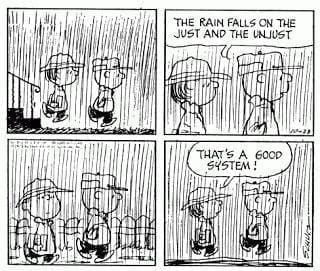
„The rain fell alike upon the just and upon the unjust, and for nothing was there a why and a wherefore.“

W. Somerset Maugham, Of Human Bondage (1915)

„He sendeth his rain, and maketh his sun to shine, upon the just and unjust.“

Francis Bacon, Of Goodness, and Goodness of Nature (1625)
Charles M. Schulz, 23. Oktober 1973

Zeitungen

Zeitungslektüre 5 (8)

Beitragsfoto: Zeitungen |  © kalhh auf Pixabay

Im Gegensatz zu Büchern sind Zeitungen eine schnelle Möglichkeit, um sich mit Sachverhalten erstmals und anfänglich auseinanderzusetzen und um an erste Informationen zu einem bestimmten Thema zu gelangen. Zudem kann man sich durch die Zeitungslektüre einen guten Überblick verschaffen, was die Welt gerade bewegt.

Auch wenn inzwischen das World Wide Web die Druckerzeugnisse langsam aber sicher zurückdrängt, werden die Zeitungen nicht obsolet, sie wechseln nur das Medium und passen sich diesem auch an.

Am Sinn und Zweck von Zeitungen ändert sich dabei aber nichts, vor allem deshalb, weil diese weiterhin am professionellen Journalismus festhalten und damit eine Mindestqualität von Informationen und auch geteilten Meinungen sicherstellen.

Unsere Meinungs- und Pressefreiheit sowie der Zugang zu Presseprodukten aus der gesamten Welt stellen darüber hinaus sicher, dass es auch für jeden Geschmack und Intellekt passende Angebote gibt – so bleibt uns eigentlich nur die Qual der Wahl.

Ich rate davon ab, sich nur auf eine einzige Zeitung, meist ist es die gleich vor Ort, zu beschränken. Unsere Meinungsvielfalt ist viel zu groß, um in einer einzigen Zeitung abgebildet werden zu können. Auch ist es einer Zeitung nicht möglich, das gesamte Informationsspektrum abzudecken, so dass man durch die Lektüre einer einzigen Zeitung den eigentlichen Vorteil von Zeitungen nicht nutzt.

Schon immer war es auch eine Geldfrage, wie viel unterschiedliche Informationen und Meinungen man erhalten kann, um sich seine eigene Meinung zu bilden.

Durch Internet und World Wide Web hat sich dies längst etwas gebessert, auch wenn „gute“ Informationen und Meinungen auch dort weiterhin ihren Preis haben – aber für einen ersten Überblick hat sich die Nutzung des Internets durchaus zum Vorteil entwickelt.

Weiterhin aber sind es die Bibliotheken und Büchereien, die dem interessierten Leser kostengünstige Pressevielfalt ermöglichen, die jeweiligen Zeitungsarchive, welche inzwischen sehr gut zugänglich sind und umfangreiche Recherchen ermöglichen, und das Zeitungs-Sharing, welches längst nicht aus der Mode ist.

Folgend finden Sie die Zeitungen, welche ich selbst immer wieder gerne zur Hand nehme oder im World Wide Web lese. Wenn Sie in diesen Zeitungen auf Recherchefehler stoßen oder Meinungen von Journalisten finden, die überhaupt nicht mit der Ihrigen in Einklang zu bringen sind, rate ich dennoch inständig davon ab, von einer „Meinungs-, Staats- oder gar Lügenpresse“ zu fabulieren, denn es wäre fürchterlich und für unsere Gesellschaften insgesamt fatal, wenn Sie in den Zeitungen immer wieder nur auf Ihre eigene Meinung und Überzeugung stoßen.

Heilbronner Stimme (Heilbronn) –> Zeitung am 22.2.2025 abbestellt
https://www.stimme.de und https://meine.stimme.de

Die Zeit (Hamburg)
https://www.zeit.de

Frankfurter Allgemeine Zeitung (Frankfurt a.M.)
https://www.faz.net

Süddeutsche Zeitung (München)
https://www.sueddeutsche.de

Neue Zürcher Zeitung (Zürich)
https://www.nzz.ch

Wirtschaftswoche (Düsseldorf)
https://www.wiwo.de

Der Spiegel (Hamburg)
http://www.spiegel.de

Le Monde (Paris)
https://www.lemonde.fr

The Times (London)
http://www.thetimes.co.uk

The Guardian (London)
https://www.theguardian.com

The New York Times (New York)
https://www.nytimes.com

Los Angeles Times (Los Angeles)
https://www.latimes.com
Sobald europäische oder gar Heilbronner Themen hier zu finden sind, gehe ich davon aus, dass diese auch die Welt bewegen.

The Economist (London)
https://www.economist.com

Ich hoffe mit meinen Vorschlägen Ihr Interesse etwas geweckt zu haben. Es würde mich dabei freuen, wenn ich Ihnen eine der aufgeführten Zeitungen schmackhaft machen konnte. Das wirklich Schöne an unserer Presselandschaft ist, dass immer noch so viele unterschiedliche Produkte zu finden sind und damit eigentlich für jeden auch das Passende dabei sein müsste.

„When we hear news we should always wait for the sacrament of confirmation.“

Voltaire, Brief an den Comte d’Argental (28. August 1760)