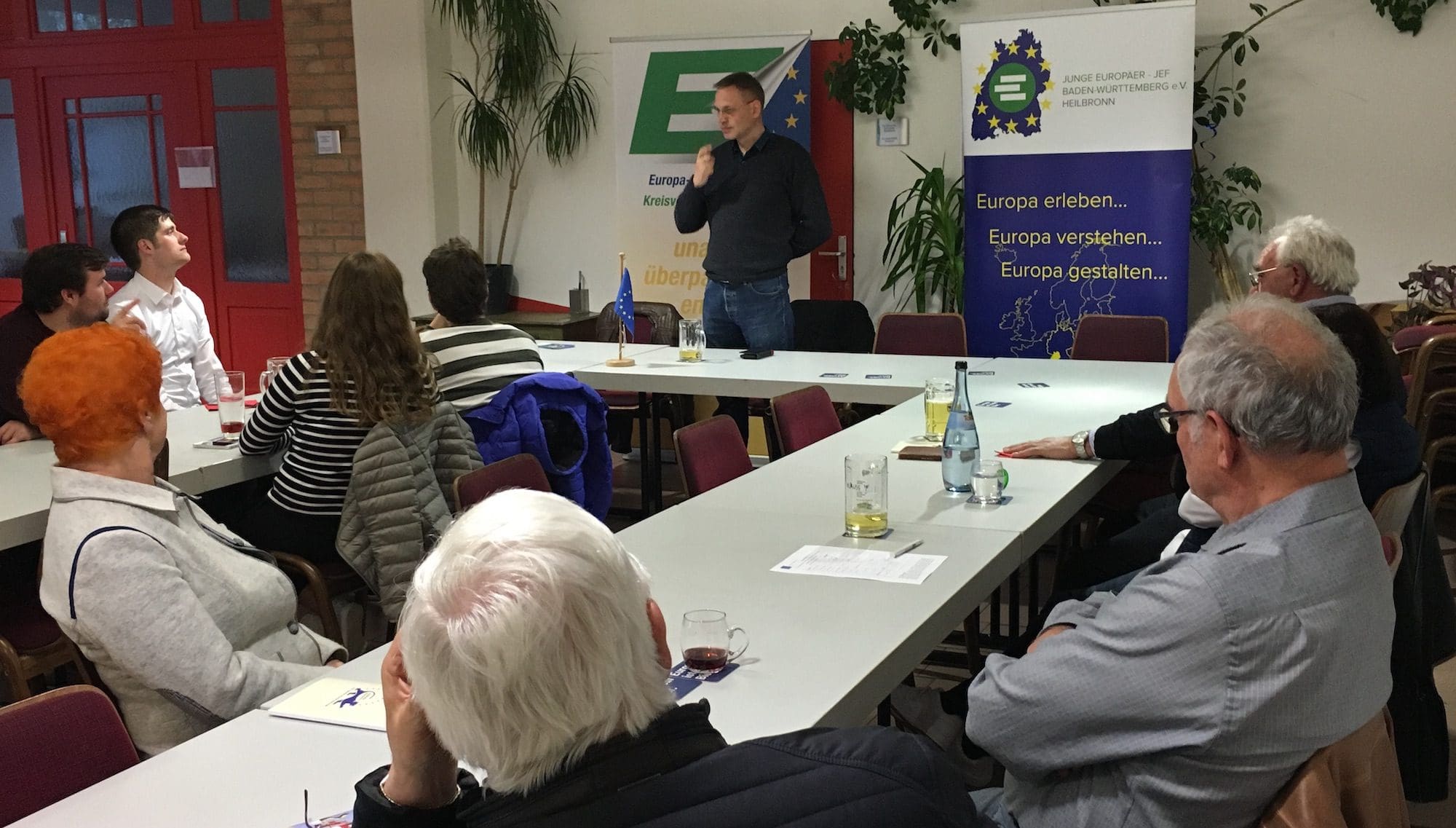
Diskussionsrunde

Konferenz zur Zukunft Europas 5 (1)

Beitragsfoto: Diskussionsrunde zur Zukunft Europas 2019 | © Bettina Kümmerle

Eigentlich müsste es inzwischen jedem bekannt sein, dass die erste Konferenz zur Zukunft Europas bereits 1946 stattfand, nämlich als sich Europäische Föderalisten im September vor 75 Jahren in Bern und Hertenstein einfanden, um ein Programm für die Zukunft Europas zu diskutieren und zu beschließen. Am 21. September 1946 war es dann auch soweit und das Hertensteiner Programm war beschlossen.

Danach kamen nicht nur Europäische Föderalisten immer wieder zusammen, um ihre Vorstellungen von einem Europäischen Bundesstaat und einer gemeinsamen Zukunft für Europa weiter zu präzisieren und den aktuellen Gegebenheiten anzupassen, sondern auch andere Europabegeisterte oder aber auch Euro-Nationalisten, die von mir schon öfters thematisierten Superstaateuropäer, warben immer wieder für ihre Vorstellungen von einem zukünftigen Europa.

Die Institutionalisten unter den Europäern wiederum bastelten spätestens seit 1951 kontinuierlich an einer europäischen Einigung und dürften froh darüber gewesen sein, dass sich bis heute weder die Europäischen Föderalisten, noch die Superstaateuropäer mit ihren Ideen für Europa durchsetzen konnten. Auch ist inzwischen die Gemengelage über die Vorstellungen eines zukünftigen Europas äußerst komplex geworden, so dass die Europäischen Föderalisten vor fünf Jahren anlässlich der Feierlichkeiten „70 Jahre Hertensteiner Programm“ begannen, mit den Hertensteiner Gesprächen in einer offenen und transparenten Gesprächsreihe über eine gemeinsame Zukunft Europas zu diskutieren. Bis 2028 soll dann ein Entwurf fertiggestellt sein, der allen Unionsbürgern den Europäischen Bundesstaat plausibel machen kann und Eckpunkte festlegt, nach denen dieser nun auch tatsächlich geschaffen werden kann — spätestens 2046, Hundert Jahre nach der ersten konkreten Idee, sollten die Vereinigten Staaten von Europa auch eine Tatsache sein!

Aber auch die weniger europäisch denkenden Mitbürger kamen jüngst zu einer ähnlichen Erkenntnis, und so riefen Emmanuel Macron und Ursula von der Leyen ganz staatsmännisch und mit großem Getöse eine eigene Konferenz zur Zukunft Europas aus.

Selbstverständlich lassen es sich die Europäischen Föderalisten nicht nehmen, um dabei ihre eigenen Vorstellungen mit einzubringen. Leider werden sie sich dort aber, ähnlich wie bereits beim Haager Europa-Kongress 1948, mit ihren vernünftigen und auch tragbaren Vorstellungen nicht durchsetzen können — die jeweiligen Partikularinteressen der „herrschenden“ Personengruppen stehen dabei weiterhin einer transparenten, effektiven wie auch effizienten politischen und gesellschaftlichen Umstrukturierung Europas entgegen.

Nichtsdestotrotz halten die Europäischen Föderalisten weiter an ihrem eingeschlagenen Weg fest und werden am 18. und 19. September 2021 die bereits 5. Hertensteiner Gespräche veranstalten; diese sind dabei auch in die „Konferenz zur Zukunft Europas“ mit eingebunden und finden dann vielleicht auch neue Interessierte, die sich bereit erklären, über ein paar Jahre hinweg, ein und dasselbe Thema in allen seinen Facetten zu begleiten und letztendlich auch zu einem Ergebnis zu bringen.

Wenn Sie jetzt ein wenig neugierig geworden sind, dann empfehle ich Ihnen den Wikipedia-Eintrag zu den Hertensteiner Gesprächen, die entsprechende Website und die bisherigen Gesprächsergebnisse, die es als E-Book zu kaufen gibt.


„Never let the future disturb you. You will meet it, if you have to, with the same weapons of reason which today arm you against the present.“

Mark Aurel, Selbstbetrachtungen (Buch VII,8)
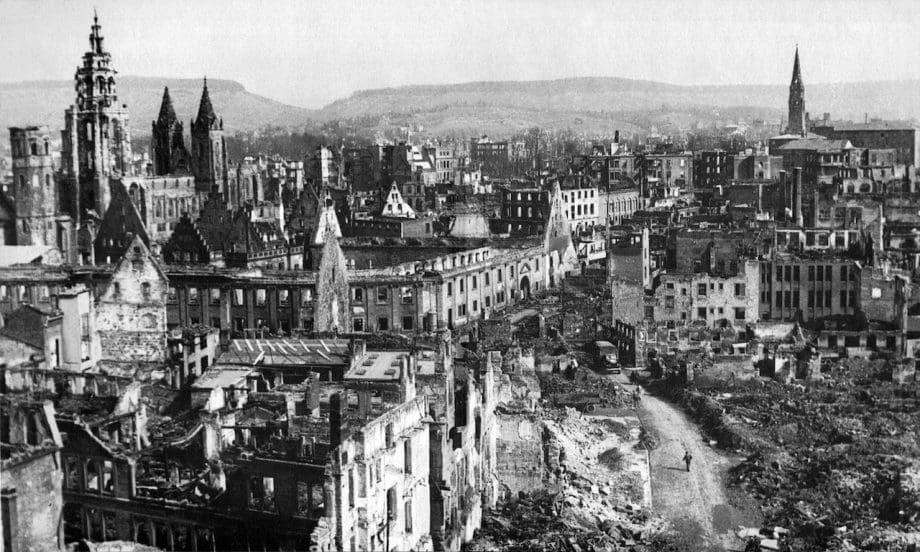
Heilbronn 1945

European Fundamentals 5 (3)

Beitragsfoto: Heilbronn 1945 | Aufnahme der US-Streitkräfte | Eingescannt von Uwe Jacobi

When the European Federalists reunited after some 17 years of separation, during which they had tried to unite Europe either as a “supranational Movement of European Federalists“ (sMEF) or as “Aktion Europäischer Föderalisten” (AEF) into a single association in 1973, they agreed on three founding fathers of the federal idea and nine fundamental documents.

Lesser known is the fact that they also changed that day the name of the European level organization from “European Union of Federalists” (UEF in French) into the organization’s name “Union of European Federalists” (still the same abbreviation, but now valid for all languages).

By the way, the “Young European Federalists” (JEF in German) reunited in 1972, which is probably why they keep this date as the date of their own foundation, which, however, actually took place on the 28th of May 1949 in Sankt Goar, Germany (“Juventus”).

The reunification congress from April 13th to 15th 1973 in Brussels, which met under the motto “The United European Federalists Fight for European Democracy”, determined that the European Federalists are inspired by Immanuel Kant, Alexander Hamilton and Pierre-Joseph Proudhon, and already listed the common fundamental documents presented in this article in the preamble of the new statutes.

The fact that Immanuel Kant and Alexander Hamilton are leaders of federalist thought is still undisputed today. In 1795, the former laid the foundation with his philosophical draft for perpetual peace for all federalists. Alexander Hamilton, one of the founding fathers of the United States of America and author of 51 of in total 85 articles in the Federalist Papers (1788), essentially laid the foundations of modern, representative democracy. Pierre-Joseph Proudhon is listed as third because he is considered to be the source of the idea of communalism (probably better known as integral federalism), which as early as 1947 were seen by the majority as the view of federalism that should actually be striven for. Proudhon is still generally known today for his provocative statement “Property is theft”, which comes from his work “Qu’est ce que la propriété? Ou recherches sur le principe du droit et du gouvernement.” (1840).

The nine foundations of federalism named by the European Federalists are the guidelines of the “Federal Union” (1939); the “Guiding Principles for a New Europe” of the Europa-Union Switzerland (February 1940); the “Ventotene Manifesto” (July 1941); the “Geneva Declarations” of the European resistance fighters (May 1944); the “Hertensteiner Program” (September 1946); the “Declaration” of the first UEF Congress in Montreux (August 1947); the “Political Resolution” of the first Congress of the EUROPA-UNION Germany (May 1949); the “Federal Charter“ adopted by the second UEF Congress in Montreux (April 1964); and the historic “Declaration of Principles” adopted at the Nancy Congress of the sMEF in April 1972.

In the meantime, several years have passed, and I, personally, deem the following documents as noteworthy and likewise important: the “Political Declaration” from the Unification Congress of the UEF itself, which was stipulated on April 15th 1973; the EUROPA-UNION Germany’s “Twelve Theses for Europe” (April 14th 1964); the “Kiel Program for Europe” of the EUROPA-UNION (June 27th 1978); its “Charter of European Identity” (October 28th 1995); and the “Charter of Fundamental Rights” of the European Union itself (December 1st 2009).

With these 14 documents listed here, one has a comprehensive overview not only of European federalism but also of federalism as a whole. This distinction is made since the World Federalists distinguish themselves from the European Federalists only in that the World Federalists have wanted to achieve a world union through a world parliament already in 1947 (constitutionalists), whereas the European Federalists decided in 1947 to first create a free Europe, then including the rest of Europe, which then would have functioned as a blueprint for other world regions and a later world union. You will find all these documents online as annexes to the book “Europe is for Everyone!” (2020)

From the very beginning, the European Federalists differentiated themselves into two strands: constitutionalists and functionalists. The former wanted to create the European federal state through a European Parliament – the Altiero Spinelli approach — whereas the latter promoted the growing together of the member states through common institutions – the Jean Monnet approach. The above mentioned split into two federalist organizations occurred since the European Economic Community entered into force, and reflects the difference between these political visions: the Italian federalists chose the constitutional method of action while the German and Dutch federalists chose functionalism.

Communalism, leading to the deepest change in European structures, emerged, at least in my opinion, out of the currents of the Ordre Nouveau (France) and the acceptance of the Christian principle of subsidiarity, and thus still today offers the only sustainable federal solution for present and future societies, of which the majority of the European Federalist was convinced already in 1947.

Therefore, constitutionalists and functionalists should consider themselves still altogether as communalists. To support this opinion, I highly recommend Michael Wolffsohn’s book “Zum Weltfrieden – Ein politischer Entwurf” (2015).

The biggest challenge to the communalist idea is in short the following: those who have made themselves comfortable in the current and mostly outdated structures are against a federal restructuring from the bottom up, starting from the municipalities, across the regions to a federal state. Thus, from the beginning, together with nationalists and centralists, they have put a brake on any further federal development and have helped to ensure that the United States of Europe as well as a future world union – which equates to eternal peace – remains a dream for many.

Furthermore, I would like to stress that the European idea is absolutely not compatible with the pan-European idea, and thus European Federalists are undoubtedly not “superstate Europeans”, who are still nationalists (Kemal Derviş sort of rebranded the pan-Europeans as such in a speech in Stuttgart in 2005). The institutional model promoted by the “superstate Europeans” is, in my view, “European nationalism”. In fact, the distinctive character of “European nationalism” is the extension of the model of the centralized and indivisible model of the nation-state to the European level, in other words, a European nation-state. Whereas the European federalists are not only convinced of the world union, which is clearly stated in UEF’s motto: “A United Europe in a United World”, but also in a pure federalist approach manifested in the motto of the European Union: “United in Diversity”.

Andrew Duff argues in his book “On Governing Europe – A Federal Experiment” (2018) that the European Federalists are strongest in those countries which exhibited an essential resistance during the Second World War. Therefore, the European idea has no fundament in the United Kingdom at all; the relicts of the Federal Union act as its exception. And that is why the British favor a European confederation. Whereas in France the former Vichy regime is still influential, causing the UEF spirit to vanish and keeping the idea of a “Europe of the fatherlands” as favorable. This also explains why the UEF spirit is mostly visible and active in Italy.

But why not in Germany? This is caused by the UEF’s birth defect which materialized in that the UEF forced the UEF members in Germany 1947 to merge with non-federalists and “superstate Europeans” in order to become an accepted UEF section with the proper name EUROPA-UNION Germany, which finally happened on November 20th 1947. The UEF representative for Germany, Ernst von Schenk, had signaled repeatedly before that only one common German organization could become a UEF section.

Nowadays, many assume that this caused the EUROPA-UNION to become the biggest UEF section, but the membership numbers show different. Over all the years, these numbers stayed the same as before the forced merger. Only on the EUROPA-UNION’s organizational boards do the “superstate Europeans” slowly but steadily poison the UEF spirit in Germany, interestingly supported by some Austrian federalists, where the pan-European idea was created in 1923.

That is why even board members of the EUROPA-UNION try to erase, for instance, the “Twelve Theses for Europe” (1964), reject an originally foreseen membership of the EUROPA-UNION in the World Federalist Movement (WFM), or even reject new UEF decisions, like promoting the transnational lists.

Even worse, all over Europe, “superstate Europeans” close their ranks in and outside of the UEF, using not only the European Movement’s network to promote the European superstate – some may even call it the IV. Reich. As a “Menetekel” you can take the “intronization” of the last president of the European Commission or the reluctance to involve parliaments and the civil society in vital decisions about the future of Europe.

While on the other side, the UEF — and this some 50 years after its reunification and some 75 years after its founding — still consists of confederalists, “superstate Europeans”, World- and European Federalists, and discusses internal procedures. Most common of all is only that UEF’s origin is not known by most of its members nor are the founding documents.

I am convinced that this knowledge would ease not only UEF’s internal communication but also the popularity and acceptance within our European societies, in which the UEF should become the main actor and mediator for the balance of interests within the European societies, whilst insisting strongly on the realization of the European idea. The European idea is the only way to create the United States of Europe – and lasting world peace!

Diesen Beitrag habe ich am 2. Januar 2021 für die Federalist Debate geschrieben, wo er in der ersten Ausgabe März 2021 erschienen ist.

Der Beitrag basiert auf einem Blogeintrag, welchen ich bereits am 4. Juni 2020 unter dem Titel „Neun plus fünf“ in meinem Weblog veröffentlicht habe, und an welchem Luico Levi, der Herausgeber der Federalist Debate, Gefallen gefunden hat.

„Die Geschichte kennen, sich mit ihr beschäftigen und über sie nachzudenken ist nichts anderes, als wenn man sich selbst in einem schönen glattpolierten Spiegel beschaut oder jemand anderen, der davor steht. Die Geschichte ist nichts anderes als wenn man in ihr das Leben, Wandeln und Handeln der Menschen erkennt, die lange vor uns gelebt haben. Manch einer denkt nicht weiter als es ihn selbst und sein Leben betrifft, geht so dahin wie unvernünftiges Vieh, das auch so für sich dahinlebt. Aber die Dinge der Vergangenheit erinnern und ermahnen uns alle, auch auf die Leute zu schauen, die als unsere Vorfahren vor vielen Jahren gelebt haben, dass wir ihr Tun und Lassen betrachten und ihre Werke beherzigen. Ja, die Geschichte kennen ist nichts anderes als um den rechten Lauf der Welt zu wissen.“  

Franciscus Lubecus, „Chronika und Anales der löblichen Stadt Göttingen“ (1570 – 1595)

Adventsgedanken

Adventsgedanken 5 (2)

Foto: Beispielbild | © Pixabay

Der Austritt des Vereinigten Königreichs wird uns Europäer – vor allem dabei unsere britischen Mitbürger – noch länger beschäftigen; jetzt bleibt nur zu hoffen, dass beide Seiten mit einem blauen Auge davon kommen werden.

Wer hätte anfangs des Jahres gedacht, dass für uns alle selbst eine solche Herausforderung von einem anderen Ereignis bei weitem in den Schatten gestellt werden wird, nämlich der Pandemie COVID-19, welche die Welt seit spätestens Ende 2019 in Atem hält und uns in Europa inzwischen das gesamte Jahr über von einem Tiefpunkt in den nächsten führt.

Besonders unsere heutige Lebensweise, und hierbei ganz besonders die Eigenart, dass man für andere kaum mehr Rücksicht nimmt, wird uns mit COVID-19 nicht nur länger als ursprünglich erwartet belasten, sondern auch mehr Opfer als nötig fordern.

Wenn man jetzt einmal von den vielen Toten und Dauergeschädigten absieht und auch nicht daran denkt, dass zudem unsere Wirtschaft und Gesellschaft schwerste Schäden erleiden müssen, weil es ganz offensichtlich europa- und auch landesweit weder geeignete Notfallpläne und Maßnahmen gibt, noch die Verantwortlichen föderale Strukturen zum Vorteil zu nutzen wissen, wird einem klar vor Augen geführt, dass Europa in der Politik eindeutig noch nicht angekommen ist – Wirtschaft und Gesellschaft sind da ohne Frage schon sehr viel weiter!

Auch müssen wir staunend erblicken, wie wenig krisenfest wir inzwischen alle geworden sind, und wie Chancen, die sich in jeder Krise bieten, ungenutzt vorüber ziehen; die Bildungspolitik ist bundesweit dabei wohl das größte Opfer.

Am Schlimmsten aber ist es, mit ansehen zu müssen, wie schwach Demokratie in Europa insgesamt aufgestellt ist! Noch vor Kurzem haben wir uns alle über die Vereinigten Staaten amüsiert, wo ein Trump vier Jahre lang regierte und dabei so schön und unterhaltend von unseren eigenen Mängeln ablenkte.

Jetzt aber haben die amerikanischen Wähler, welche von uns Europäern so gerne als dumm und hinterwäldlerisch gesehen werden, uns klar und deutlich vor Augen geführt, wie Demokratie geht, und ganz nebenbei auch, wie man Föderalismus positiv für alle nutzt.

In Europa hingegen, schaulaufen die Orbans und Co. ungestraft, und dabei seit Jahrzehnten gerne und immer wieder gewählt, wobei sie mit ihrer kriminellen Energie selbst alles in den Schatten stellen, was wir eigentlich sonst von Bananenrepubliken erwarten würden.

Aber auch bei uns bekennen sich nicht mehr alle Parteien ohne Wenn und Aber zur Rechtstaatlichkeit, wie sonst soll man z. B. das Festhalten an der Orban-Partei in einer europäischen Parteienfamilie verstehen.

Zudem wirken sich solche Antidemokraten nicht nur durch ihre Veto-Eskapaden auf unseren eigenen Alltag aus, sie bestimmen mit ihrer antidemokratischen Anhängerschaft selbst bei uns immer mehr die Gesellschaftspolitik.

Auch das Verständnis für Gewaltenteilung und deren Funktion geht insgesamt immer weiter zurück, Gerichte werden inzwischen nicht nur mundtot gemacht und Richter verfolgt – Polen darf hier als prominentes Beispiel dienen –, sondern auch unsere Parlamente von selbst immer stiller.

Wenn uns COVID-19 eines gezeigt hat, dann, dass wir zu unserem eigenen Wohle nur noch zumindest in europäischen Dimensionen denken und handeln dürfen; alles andere ist zu kurz gesprungen: das Après-Ski in Ischgl wirkt sich bei uns in Baden-Württemberg genauso aus, wie z. B. ein Nullprozent Steuersatz für Firmen in Irland. Und auch ein COVID-19-Hotspot Heilbronn wird nicht folgenlos für den Rest Europas bleiben.

Wir benötigen zwingend europäische Konzepte und Lösungsansätze, diese aber föderal angepasst und umgesetzt. Wir benötigen mehr Demokratie und nicht weniger, und die Rechtstaatlichkeit muss uns Europäer einen und nicht entzweien!

Die einzige Grenze Europas ist bekanntlich die Demokratie – diese müssen wir ziehen, selbst dann, wenn sie durch ganz Europa führt!

„Ich kann Euch zu Weihnachten nichts geben, ich kann Euch für den Christbaum, wenn ihr überhaupt einen habt, keine Kerzen geben, kein Stück Brot, keine Kohle zum Heizen, kein Glas zum Einschneiden. Wir haben nichts. Ich kann Euch nur bitten, glaubt an dieses Österreich!“ 

Leopold Figl, Weihnachtsansprache 1945